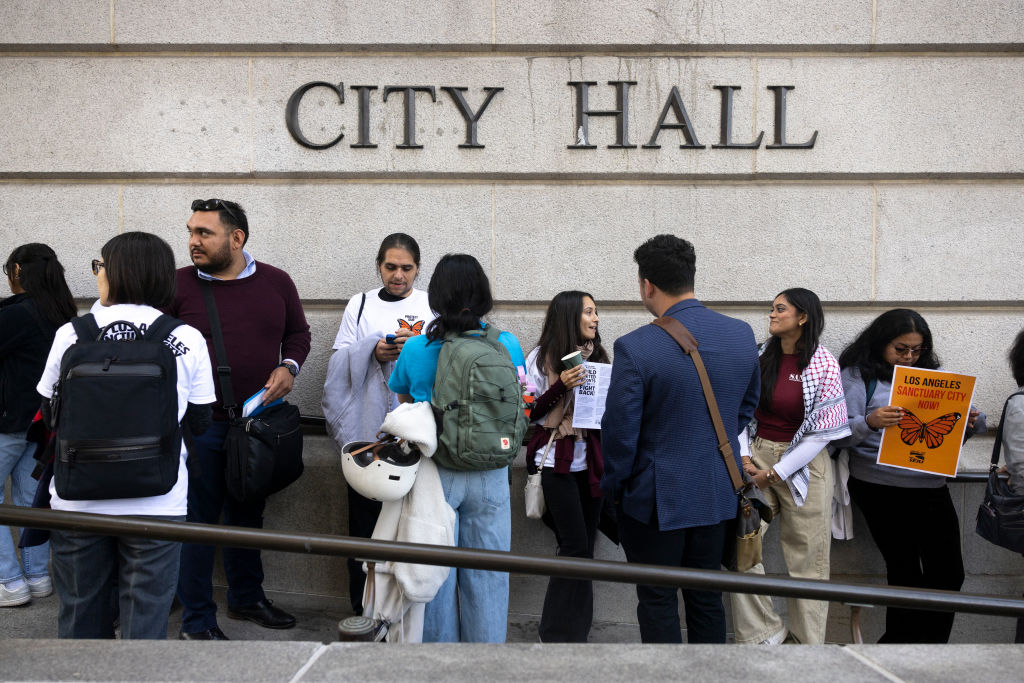
Etienne Laurent/AFP via Getty Images
U.S. immigration policies and their enforcement disproportionately affect Latinx families, consequently impacting the mental health of Latinx adults, adolescents, and children, whether they are immigrant or native born. Detention and deportation have myriad economic, legal, and social consequences which are, in turn, associated with poor mental health.12 Fear of detention and deportation also negatively affect mental health.23
Together with Cecilia Ayόn, PhD and team, our Foundation-funded study asked: Can sanctuary city policies offset the negative health effects of immigration policies and enforcement? This post outlines the study’s questions, interprets its findings, and shares directions for future research.
Local Intervention: Sanctuary City Policy
Sanctuary policies emerged in the late 1980s to protect immigrants from restrictive immigration policies and enforcement. They designate a state, county, or city as a “sanctuary” to protect immigrants, such as by prohibiting use of local funds or resources to further federal immigration enforcement. As of December 2018, 82 of California’s 482 cities had sanctuary policies, including eight of the largest cities: Anaheim, Berkeley, Long Beach, Los Angeles, Oakland, Sacramento, San Francisco, and San Jose. While prior studies focused on restrictive policies and state or national policies,45we focused on sanctuary policies and city policies. Specifically, we examined whether sanctuary city policies positively affect Latinx mental health in California.6
Sanctuary City Policy and Latinx Mental Health
We created a city-level dataset of sanctuary policies by reviewing the legislative records of each of California’s 482 incorporated cities for sanctuary enactments through December 2018. Sanctuary policies include directives that expressly forbid city-level officials, including law enforcement, from inquiring into the immigration status of residents and/or cooperating with the U.S. Immigration and Customs Enforcement. Our dataset indicates each city’s sanctuary status as of December 2018 and the month and year of the policy’s passage. We then linked this data with person-level data from the California Health Interview Survey (CHIS), the largest state-level health survey in the US. The CHIS uses landlines and cell phones to gather information and provides representative data on California’s non-institutionalized population living in households. It interviews adults (ages 18 and above), adolescents (ages 12 through 17) and via proxy adult respondents, children (ages 11 and below).7
After using propensity score matching to identify non-sanctuary cities comparable to sanctuary cities, we estimated respondent-level difference-in-differences models to determine whether sanctuary city policies had beneficial mental health effects during the period 2007–2018. We compared the mental health of Latinxs before and after sanctuary city enactment in sanctuary cities and matched non-sanctuary cities. We hypothesized that residing in a sanctuary city, relative to residing in a non-sanctuary city, would be associated with better mental health for Latinxs. Specifically, we hypothesized that the benefits would be greatest for undocumented immigrant Latinxs, since they are explicitly targeted by the policy, followed by documented immigrant Latinxs and native-born Latinxs whose exposure to racialized enforcement may be reduced by the policy. We tested these hypotheses separately with adults (N = 142,000), adolescents (N = 6,400), and children (N = 13,000).
Although we found a trend toward improved mental health in sanctuary cities after policy enactment, the patterns of mental health in the three Latinx immigration sub-groups of each age group did not conform to our hypotheses. We observed no relation between the enactment of sanctuary city policies and mental health. The difference between pre- and post-mean mental health among adults in both non-sanctuary cities and sanctuary cities was higher after policy enactment, consistent with trends in the US over time of an increase in reported mental disorders. Yet, the increase in adult distress in control cities was greater than the corresponding increase in sanctuary cities. The difference between these increases was − 0.15, indicating descriptively that adults in sanctuary cities reported a smaller increase in distress after sanctuary policies were implemented than did adults in control cities. We found similar results among adolescents and children.6
The patterns of mental health also did not conform to our hypotheses about sanctuary city impacts by origin and immigration status (i.e., foreign born “undocumented,” foreign born “documented,” and native born). Our analysis of the three Latinx sub-groups revealed no statistically significant relation of sanctuary city policy to mental health. While sanctuary city policies did not reduce distress in the group it was intended to benefit (i.e., the undocumented subgroup), it did not aggravate their distress either.6
Our hypothesis of the mental health benefit of sanctuary city policies assumed that policy enactment would reduce Immigration and Customs Enforcement (ICE) apprehensions. We examined trends in county-level ICE arrests and found that they trended downward at the end of President Obama’s administration and then, upward in President Trump’s first administration. A majority of sanctuary city policies were enacted in this latter period. ICE arrests increased, despite the increased passage of sanctuary city policies. The increase in federal enforcement activity has been attributed to a concerted effort by the Trump administration to punish California for its sanctuary state status. Thus, although city-level data on ICE arrests were not available, our analysis of county data suggests that the assumption of reduced apprehensions in sanctuary cities was false.6
Interpreting the Findings: Directions for Future Research
We convened a panel of six community representatives from immigration-related advocacy, policy, and human services organizations in California to elicit their interpretations of the results and discuss future directions. Drawing on their ideas, here we offer several possible explanations for the results and propose areas for further research.
Federal immigration policy remains an important influence on Latinx mental health. Sanctuary city policies were implemented in the context of an alternative “treatment” in the form of heightened federal immigration enforcement in the state. These countervailing initiatives may have offset any potential individual-level benefits of sanctuary city policies. The evidence of increased ICE raids—potentially in response to the enactment of sanctuary policies—supports this possibility.
Sanctuary city policies may not have been effective because there was insufficient awareness or understanding of it among city residents. New research might explore whether increasing public awareness of sanctuary city policies improves city residents’ public health. A related possibility is that if aware of the policies, people did not feel protected by them because their activities of daily life require them to circulate in more than one city, including cities that may have no sanctuary policies or an anti-sanctuary policy. Thus, one city’s policy may not have reduced residents’ exposure to risk. Future studies should examine potential sanctuary county policy effects, given federal coordination with county-level prison and jails, suggesting that a sanctuary county, in contrast to a sanctuary city, may provide more reprieve from immigration enforcement.
Sanctuary city policies may be insufficient to counter the well-documented long-term mental health consequences of decades of restrictive immigration policy, affecting multiple generations of people.891011 They do not expand mental health services which, even if fully accessible, may not meet the demand for them. Additionally, the level of intervention may explain the lack of a mental health benefit. Local policy may be unable to overcome the mental health effects of federal policy. Additional studies should investigate the effects of alternative policy strategies, such as expanded mental health services for Latinx and immigrant youth.
Local policy may create momentum to change policy at higher levels. Research on public policy has shown that lower-level policy can drive higher-level policy. The presence of sanctuary city policies may signal to policy advocates that they can achieve other policies and lay the political groundwork for policies at other levels which could have a future impact on mental health. For example, the Health4All Campaign in California advocates for state support for access to health care for all people, regardless of immigration status. In 2016, it succeeded in getting health care coverage for children, regardless of immigration status, and in 2019, the coverage extended to people up to age 26.1213 Thus, sanctuary city policies may produce fertile ground for the growth of other immigrant-inclusive policies. Future studies might ask: What impact might these other immigrant-inclusive policies have on Latinx mental health outcomes?
Conclusion
Though our study did not find a relation between the enactment of sanctuary city policies and mental health outcomes, additional research can illuminate other avenues for protecting immigrant youth. Especially as current immigration enforcement escalates, scholars conducting new research should examine alternative policy strategies (e.g., expanded health care access), policy momentum effects, public awareness of sanctuary policies, the relation of sanctuary city policies to other mental health measures and other non-health measures that may be mechanisms of effects on mental health, and the clustering of city policies as potential geographic bubbles of protection.
- Nichols, V.C., LeBron, A.M.W. & Pedraza, F.I. (2018). Policing us sick: The health of Latinos in an era of heightened deportations and racialized policing. Political Science and Politics, 51(2), 293-297. DOI 10.1017/S1049096517002384
- De Genova, N. (2002). Migrant illegality and deportability in everyday life. Annual Review of Anthropology, 31, 419–447.
- Ryan, D., Tornberg-Belanger, S.T., Perez, G., Maurer, S., Price, C., Rao, D., Cham K.C.G., & Ornelas, I.J. (2021). Stress, social support and their relationship to depression and anxiety among Latina immigrant women. Journal of Psychosomatic Research, 149, 110588. https://doi.org/10.1016/j.jpsychores.2021.110588
- Hatzenbuehler, M.I., Prins, S.J., Flake, M., Philbin, M., Somjen Frzer, M., Hagen, D., Hirsh, J. (2017). Immigration policies and mental health morbidity among Latinxs: A state level analysis. Social Science and Medicine, 174, 169-178.
- Philbin, M.M., Flake, M., Hatzenbuehler, M.L., & Hirsch, J. (2018). State-level immigration and immigrant-focused policies as drivers of Latino health disparities in the United States. Social Science and Medicine, 199, 29-38. doi: 10.1016/j. socscimed.2017.04.007
- Nieri, T., Ramachandran, M., Bruckner, T.A., Link, B., & Ayόn, C. (2023). Sanctuary city policies and Latinx immigrant health in California. Social Science and Medicine – Population Health, 21, 101319. doi: 10.1016/j.ssmph.2022.101319
- California Health Interview Survey. (2017). CHIS 2015-2016 methodology series: Report 1 - sample design. Los Angeles, CA: UCLA Center for Health Policy Research.
- Artiga, S. & Ubri, P. (2017). Living in an immigrant family in America: How fear and toxic stress are affecting daily life, well-being, & health. Retrieved from: https://www.immigrationresearch.org/report/other/living-immigrant-family-america-how-fear-and-toxic-stress-are-affecting-daily-life-well
- Ayón, C. & Nieri, T. (forthcoming). Toxic immigration stress: How the US immigration policy climate negative affects Latinx Undocumented older adults: Social integration, economic wellbeing, and health. In A.C. Onyewuenyi & S. Wiley (Eds.), Research Handbook on the Psychology of Migration. North Hampton, MA: Elgar Publishing.
- Barajas-Gonzalez, R.G., Ayón, C., & Torres, F. (2018). Applying a community violence framework to understand the impact of immigration enforcement threat on Latino children. Social Policy Report, 31(3), 1-24.
- Almeida, J., Biello, K.B., Pedraza, F., Wintner, S. & Viruell-Fuentes, E. (2016). The Association between anti-immigrant policies and perceived discrimination among Latinos in the US: A multilevel analysis. SSM – Population Health, 2, 897-903.
- See https://health4allkids.org/
- California Legislative Information. Downloaded on 2/18/22 from https://leginfo.legislature.ca.gov/faces/billNavClient.xhtml?bill_id=202120220AB4 UCR School of Public Policy