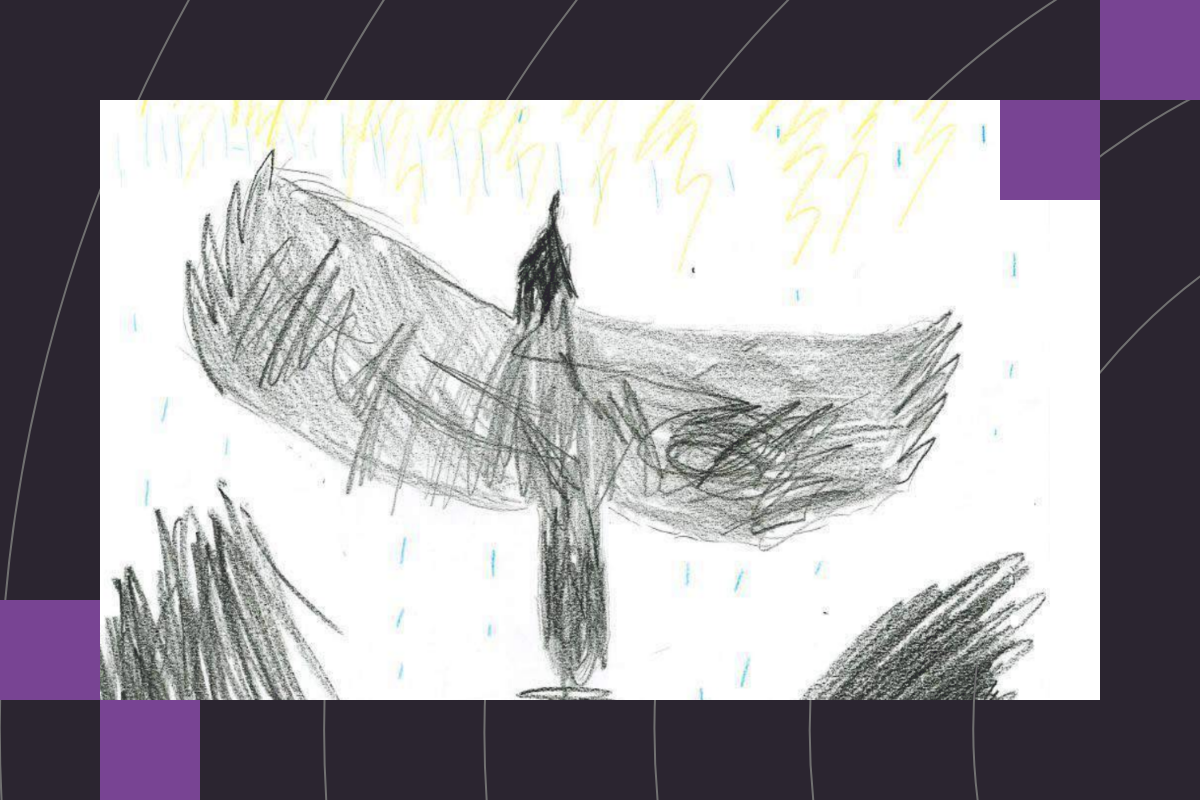
Illustration from Picksee: The Curious Little Crow, courtesy of the authors
During a symposium held at the University of Washington, Black boys, families, and educators from Seattle Public Schools beamed with pride and joy. Over 200 educational leaders and scholars gathered to hear from experts in the field on research-based practices to foster equitable learning environments, but few expected that expertise to come from the children and families at the front of the room. Eight, nine, and 10-year-olds read from the book they co-wrote in four languages. They talked about the fun of creating with their friends, families and teachers, invoked their ancestors’ guidance, and shared their ambitions of writing poetry and becoming astronauts. Everyone in the room leapt to their feet after their presentation. Not a few of us wiped tears from our eyes.
The symposium was one of the culminating activities of our Research-Community-Practice Partnership, called the Early Literacy Collaborative (ELC) RCPP. Supported by the W.T. Grant Foundation, the ELC sought to transform Black family-educator collaboration in Seattle by codesigning culturally affirming early literacy practices with Black families and educators. The ELC was the latest iteration of a long-term partnership between University of Washington researchers and Seattle Public School (SPS), spanning across 10 years, 4 different phases, 3 superintendents, and 58 core faculty, community, and district partners.
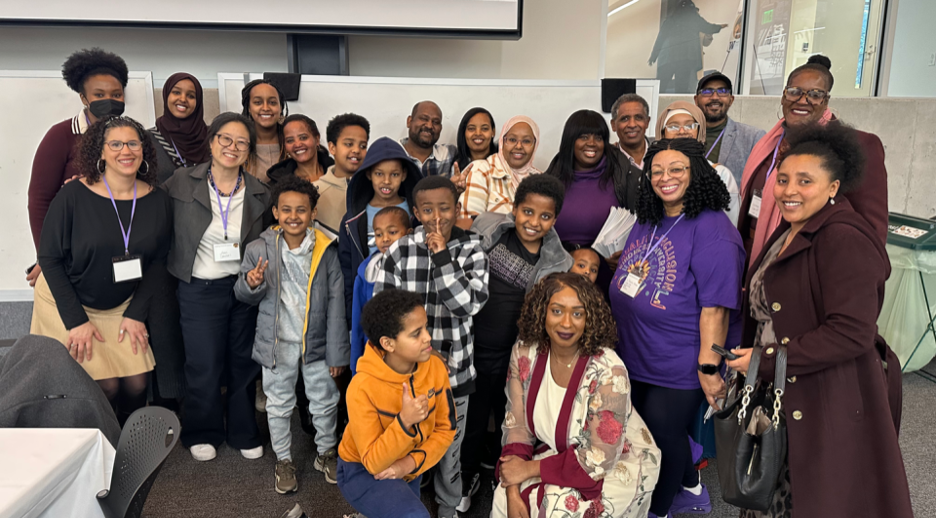
ELC families and educators at the University of Washington’s Leading towards Justice Symposium
The partnership has weathered a lot, persisting through constant turnover, a global pandemic, a nationwide racial reckoning, a $131 million budget deficit, and dramatic shifts in the sociopolitical context in and around public schools. But despite widespread institutional retrenchment from racial equity work, the Black women district and community leaders at the helm of the ELC never stopped building.
Here, we share the design principles that sustained the ELC’s justice-driven work, even as systems pulled back (see figure 1). These principles came to reflect our collective and iterative strategy for creating and nurturing the conditions for solidarity-driven co-design with Black boys, families, community, educators, and leaders. While all six principles are crucial to the partnership, we highlight three here.
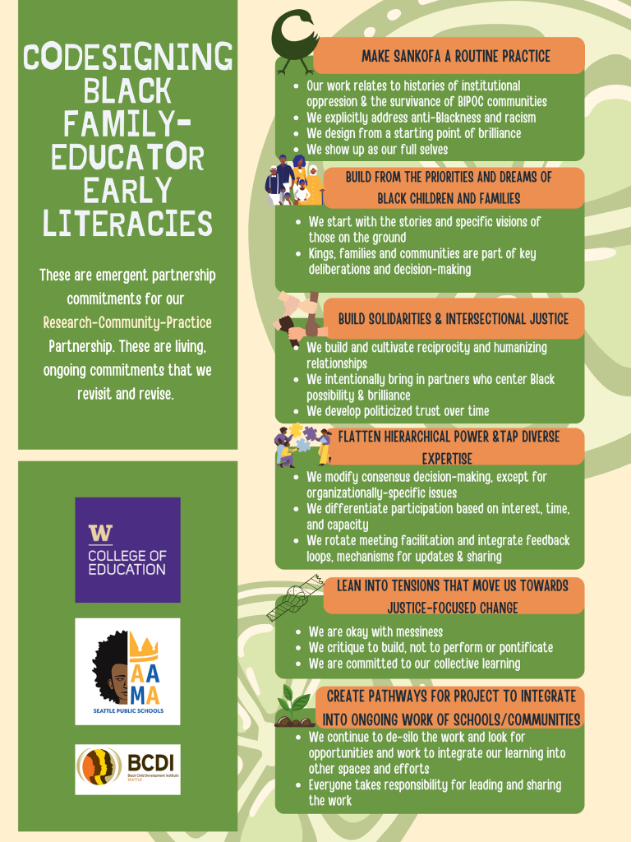
Figure 1
Make Sankofa a routine practice
Sankofa is an African word from the Akan tribe in Ghana, meaning to look back before moving forward. The literal translation of the word and the symbol is “it is not taboo to fetch what is at risk of being left behind.” With each iteration of our collaboration, the Sankofa bird flew with us, guiding us even when we weren’t aware of it. Partnerships rooted in dynamic urban K-12 school systems are complex, challenging, and full of tensions. Yet as a routine, Sankofa gave us space to elevate our sights from the frustrations of the ground to remember what we built, what we learned, and what survived in order to move toward transformative futures.
With Keisha’s leadership, we adopted Sankofa as an organizing principle for how we would enter and open in community with each other, launch into our work, and collaborate with each other. When the RCPP focus turned to cultivating Black boys’ early critical literacies, UW faculty member Dr. Dana Nickson opened our first codesign planning meeting with an invitation to each share an experience of joy from our own literacy learning as children. Black women leaders in the partnership retrieved their experiences of homeplace1 at their grandmother’s house and around the kitchen table. This opening grounded us in an expansive conception of literacies that already exist in families and communities.
Moving forward without looking back inevitably risks leaving something important behind. Therefore, we intentionally established this core principle to capture things that might otherwise be left behind: community voices, founding commitments, the original questions that started the work. Sankofa, as a practice of return, is how we kept finding our way back to these grounding commitments and vision.
Build from the priorities and dreams of Black children and families
When a top-down mandate from the district instructed schools to raise the third grade reading test scores of Black boys, we knew we had to jump into action. The directive was at odds with the work Mia had been leading as the executive director of the Office of African American Male Achievement (AAMA): Black boys and young men, referred to as Kings, and their families were not demanding remedial reading interventions or test preparation. They wanted welcoming, joyful, and safe learning environments and teaching that affirmed their Black identities. They wanted strong relationships with mentors and teachers who reflected their community. They wanted family and community insights to inform decisions.
This meant that researchers and district administrators could not be the only ones designing change. If we were serious about racially equitable systems, we had to collaborate with youth, families and communities, rather than implement changes based solely on our ideas of what was best for them. The priorities and dreams of Black children and their families offered a North star for our partnership. We had to find a way to address the district mandate while prioritizing what the AAMA had already heard from Black Kings.
We used this principle to shape our design sessions. The codesign emerged from deep discussions about finding harmony between students’ school contexts and ancestral, community, and cultural knowledges. We built the pedagogical foundation for the codesign by asking families to share how they taught their children about their history, cultures, language, and values. We doubled down on what the Kings and their families had said, insisting that academic rigor, identity, and relationality were intertwined.
Through these iterative and creative discussions, the kings, their families and educators created a story in English, Amharic, Tigrinya, and Somali. Picksee: The Curious Little Crow begins:
There is a curious little crow named Picksee who is not like other crows. He is especially smart and has wisdom.
Every day, Picksee travels from home to school holding a fruit. The fruit is beautiful like the teachings from his family and ancestors.
One day, Picksee spots a shiny object in the ocean and wonders what it is. The shiny object looks like something he learns from school. He gets distracted. Picksee drops the fruit he’s holding while focusing on the shiny object. It is heavy and difficult to hold both. Picksee struggles to find his fruit and hold the shiny object. Then a storm comes, and he loses his way…
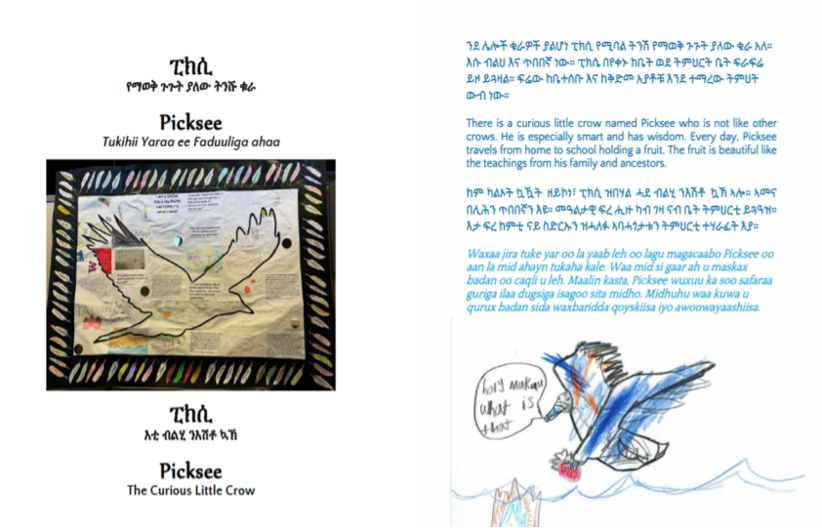
Picksee: The Curious Little Crow
The Kings decided on a choose-your-own-adventure ending, literally putting themselves at the helm of their own futures. More than the book itself, though, the project engaged over 70 students, families, and educators in codesigning practices for partnering with Black families to develop early literacy learning that met the priorities that the Kings and their families had identified to AAMA: joyful, culturally affirming, intergenerational learning.
Create pathways to integrate into ongoing work of schools/communities
All along, we debated how to ensure that our RCPP efforts would contribute to systems change, even if funding dwindled, priorities shifted, individuals turned over, and typical district operations and norms encroached. We strategized how to “teach the system” and invited leaders from many different departments across the district to learn about the ELC. We also provided professional development for leaders, teachers and racial equity teams, presented to the superintendent and executive cabinet, and developed toolkits, surveys, and other resources to support educators and schools in taking up transformed literacy practices.
But when the district quietly eliminated crucial family literacy connector roles (most of whom were Black mothers), dramatically reduced AAMA staff and literacy resources, eliminated the entire district partnership department, and sunset the strategic plan that lifted up Black boys, we began to look outside the district to find support for the families. Delighted to welcome so many Black families into their space, Seattle Public Libraries connected their local branch children’s librarians with each school and pledged support and space to enable families to sustain and grow their work.
This design principle helped us look beyond the school district to the broader community ecosystem of education and learning spaces. Even as external pressures to erase Black histories and culture have intensified and many educational systems retreat from prior racial equity commitments, joyful intergenerational literacy learning and Black identity-affirming education persists in the broader community ecosystem.
Concluding thoughts
Our 10+ years of partnership have taught us that the justice we seek to realize in education must also live in our processes of partnering. The attacks on equity in education are likely to continue, but we invoke the practice of Sankofa to remember that Black, Indigenous, immigrant and other minoritized communities have been through dark times before. By turning back to retrieve what was left behind, we offer ways forward for continuing the work of equity-centered RCPPs to realize educationally just futures:
Don’t go alone. Bring the students, families and communities directly impacted by educational injustices into the conversation from the beginning, not as an afterthought or as a source of data to support a pre-determined agenda. Given time, space, and thoughtful facilitation, youth and families can contribute transformative knowledge and approaches for reimagining learning and education.
Don’t depend on a single institution. Sustained change-making does not depend on any single institution’s commitment to justice work. Instead, we can cultivate “relational infrastructures”2 that move across multiple institutions to reside in the broader ecosystem of communities.
Build your principles into your partnering practice. While many partnerships and initiatives espouse shared commitments and values, they can too easily remain abstract words and aspirations. Developing routine practices that embody your principles ensures that they live in the activity of partnering.
Keep sight of your anchoring motivation. As others in equity-focused RPPs have noted, “mutuality” and research use were never our central aims: Our primary motivation for partnering was always to advance racially equitable systems change in education. We were less focused on what we could each get out of the partnership than on how we might transform the P-12 system and the learning experiences and opportunities of students marginalized by those systems—in the words of the district, those “farthest from educational justice.”
Even if formal institutions leave community wisdom behind, justice-centered RCPPs rooted in community ecosystems can plant seeds that continue to grow possibilities for liberatory education long into the future.
• • •
The authors thank Dr. Mia Williams, Dr. Dana Nickson, and Dr. Sefanit Habtom
- hooks, b. (1990). Homeplace: A site of resistance. In b. hooks (Ed.), Yearning: Race, gender and cultural politics (pp. 41–49). South End Press.
- Gutiérrez, K. D. (2026). Why speculative? A future-oriented case for youth labeled as disabled. Teachers College Record: The Voice of Scholarship in Education, 128(7), 185-193. https://doi.org/10.1177/01614681261485041