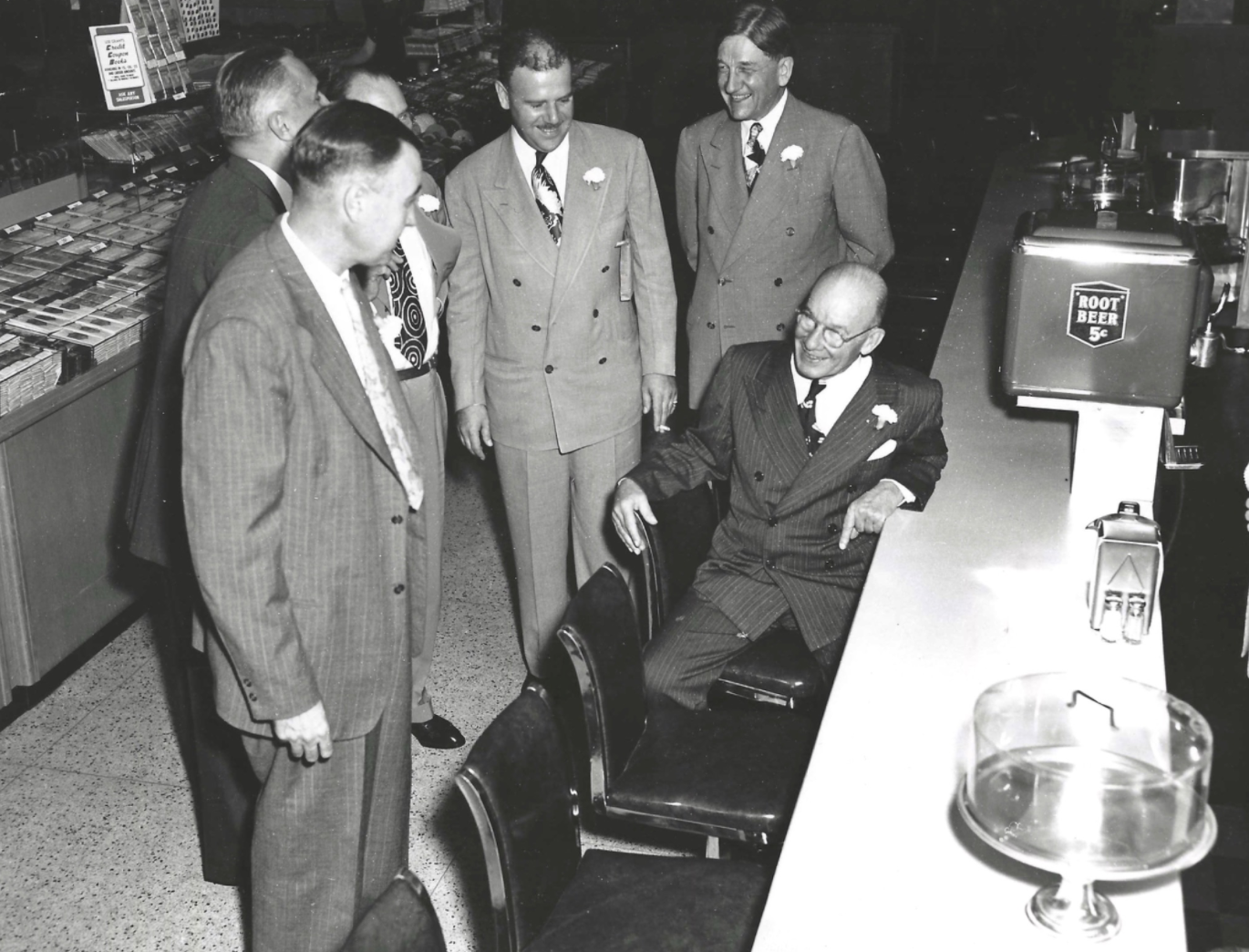
One hundred and fifty years ago this month, on June 27, 1876, visionary entrepreneur and retailer William T. Grant was born in Stevensville, Pennsylvania.
Grant opened his first department store, Grants, in Lynn, Massachusetts, in 1906. Over the following decades, he transformed his company from a regional chain to a nationwide retail empire that captivated shoppers with its variety of goods and value prices. The company dissolved in 1976, but Grant’s legacy continues to live on today: Because of his philanthropic endeavors, the William T. Grant Foundation has supported research to improve the lives of young people for 90 years and counting.
To commemorate Grant’s 150th birthday, we sat down with Eric Johnson, author of the new book, “The W.T Grant Company: Known for Values.” Drawing from his personal experience growing up shopping at Grants, along with extensive research from the Rockefeller Archive, Johnson tells the rich history of Grant’s life and the company he built.
In a conversation with the Foundation, Johnson discussed the inspiration for the book, the rise and fall of the company, and Grant’s lasting impact. This interview has been edited and condensed for clarity.
What led you to write the book?
The inspiration for the book was that I grew up with Grants from an early age. In 1968 when I was three, Grants built a Grant City in my neighborhood on the northwest side of Milwaukee. Between 1968 and 1975 when the store closed, the Grant City was our neighborhood store. We were there quite often. It was part of a strip shopping center: There was a National Tea supermarket and a Walgreens on one end, and then we had 120,000 square foot Grant City on the other. For a young child, between the toy sections and Pat’s Bradford House restaurant, where we dined a couple times a week, it was the most wonderful store in the world. It was tied up in a lot of happy memories, and understandably, at age 10, I was pretty crushed when the store closed and the company ultimately went out of business.

Eric Johnson outside Art Deco-styled former W.T. Grant Co. Store No. 31 in Rockford, Illinois.
That was the inspiration for [the book], a very early love for Grants. My family and I moved south of Milwaukee to Racine, and across the street from my high school was an old variety store style of Grants in the shopping center across the street. That rekindled my curiosity. I spent my high school years as a nerdy kid, going through the reader’s guide of periodicals, looking up everything I could find about Grants, the William T. Grant Foundation, and William T. Grant himself. A lot of that early research was pivotal in jumpstarting the book project.
Is there anything you were surprised to learn about William T. Grant and/or his company while researching for the book?
Part of what I found fascinating was the backstory itself. [Grant] was sort of a character out of a Horatio Alger book. He came from very modest, almost poor, humble beginnings and built himself a billion-dollar retailing empire—a rags to riches story. He was the son of a very optimistic but star-crossed retailer, his father William T. Grant Sr. He was captivated by the stories that his father brought home about all the wonders of working in the retail business. His brother Elihu was the rogue scholar of the family, where William T. Grant wasn’t so much interested in book learning; he was more of the hands-on type. He dropped out of high school, immersed himself in the retail industry, went from one job to another, and eventually wound up with some of the leading Massachusetts department stores, where he found some people that took him under his wing.
He tried out some ideas that he had, including the idea which started the William T. Grant Company. His idea was, you had your traditional five and dimes, like F.W. Woolworth and S.H. Kresge on the one end, and then you had your 50 cent and up department stores, like Macy’s and what would become JCPenney. His idea was to pilot a 25-cent store in between two, which for its day was a very radical idea. It found huge popularity and huge acceptance, and it blossomed the W.T. Grant Company in full flower.
What lessons can we learn from the rise and fall of the Grants stores?
The outside-the-box thinking, from its very founding, basically paved the way for the Walmarts and the Kmarts of the later years, in between today’s Dollar Tree and Dollar General, and Macy’s and Nordstroms on the other end. It found that niche. The company was constantly innovating. Very early, it introduced independent opticians into its stores in the 30s, and in the Depression era, dabbled with groceries. It was one of the first companies that followed the post-war boom into the suburbs. So it was very cutting edge for a long time.
Grant was sort of a character out of a Horatio Alger book. He came from very modest, almost poor, humble beginnings and built himself a billion-dollar retailing empire—a rags to riches story.
It started missing its way, it began to lag behind, and unfortunately a perfect storm of ills, including some self-inflicted [primarily, widely issuing store credit beyond what the company could absorb], ultimately brought the company down. It was very sad to see, because for so many reasons it had grown into such a success story. To watch it crash and burn so spectacularly in a very short period of time was certainly disheartening.
The book includes an interview with a former Grants store employee. What did the Grants stores mean for the people who worked, shopped, and lived near them?
The interview was with Albert Duclos, who managed a Grants store in Westerly, Rhode Island. He popped up on my radar back in high school, in a Fortune magazine feature story when Grants was going through its bankruptcy. The story ended with his store padlocked awaiting liquidation, and I always wondered what happened to Albert Duclos. Through the miracles of modern technology, I was able to track down Albert Duclos, as well as Rush Loving, who wrote the story. Both men were in their mid-80s when I interviewed them, but they both had vivid recollections. It was interesting to get their perspective on the story all these decades removed, kind of their post-mortem of the company and its legacy.
The Grants stores themselves had a family feel, and William T. Grant promoted that. The stores had social gatherings for employees, whereas the retail industry today is a revolving door for employees. Because of the way the Grants stores were set up, people stayed for entire careers, from the executive suite down to the store floor. That was part of what unfortunately was lost with the company’s demise. But there were employee groups that kept together with lunches and newsletters for decades after the company went out of business. There was also such a tight family-knit culture for the customers. The company had an incredible amount of goodwill in the communities that it served.
The company’s slogan was “known for values.” How does the Foundation reflect the values and perspectives of William T. Grant?
You can take the word values a couple different ways. Obviously on the business level, it was selling high quality goods at low profit margin and making money on the volume that creates. He was coming at it from an economy-minded perspective, but he was also big into values in the traditional sense in the way that the company was run. He was very much a stickler for doing business the right way and treating customers and employees well. That sort of thing eventually followed itself into the establishment of what was then known as the Grant Foundation, now the William T. Grant Foundation.
Eventually, he found what he called the “new idea,” which was taking his millions and spending it for a better purpose to improve the lot of mankind and to help people who had limited means.
When he retired in 1924, he stayed on as chairman of the board and oversaw the company, but he stepped out of the day-to-day operations. He went from rags to riches and had more money than he could possibly have imagined when he opened the first Grant company store. But if you read into his story, William T. Grant made millions for himself, but it didn’t buy happiness for him. Eventually, he found what he called the “new idea,” which was taking his millions and spending it for a better purpose to improve the lot of mankind and to help people who had limited means. How can we help people meet their best potential in life, to live a happy life, to live a productive life? That became the philanthropic [ethos] for William T. Grant that set up something that certainly survived him, survived the company, and endures to this day. It has gone through various changes and focus over the years, but ultimately it’s still aimed at how we can improve lives for people.
How would you characterize the legacy of William T. Grant today?
In the years after the demise of the company and his passing in the early 1970s, his legacy was troubled for a time when [the company] came out of the bankruptcy. But now, what it comes down to is he was a visionary in a number of ways. He was a visionary retailer, piloting a lot of firsts in the industry, and turning the William T .Grant Company into an industry leader. The company had a proud legacy over almost its entire run: It was a growing company, an innovating company, a much-beloved company. What you find all these decades removed, is there’s an enduring fondness for the Grants company, and scores of memories out there. In the long run, both William T. Grant and the W. T. Grant Company stood the test of time.
A lot of the early chapters of the book are very much in William T. Grant’s voice, in that you’re hearing him talk about his business philosophies and his philosophy in starting the William T. Grant Foundation. I’m very proud that his voice comes out in the book as a testament to him as a man, and it was a pleasure to highlight the work of the Foundation, which continues the legacy of the company.
To learn more about the history of the William T. Grant Foundation, read “The William T. Grant Foundation: The First Fifty Years 1936-1986.”