Local students celebrating the end of the Starr Hill Pathways summer camp. Photo courtesy of the UVA Center for Community Partnerships. Photo credit: Sydney Shuler.
As an R1 institution, the University of Virginia has a long history of partnership and engagement with the local community. However, these efforts have sometimes been marred by inconsistency and lack of coordination. Often, the community has viewed such partnerships as designed to serve the university rather than to benefit the community.
In support of the UVA 2030 Strategic Plan’s commitment to strengthen democracy, expand access, and foster service to the public good, the Center for Community Partnerships was created in 2019. The core mission of the Center is to operationalize UVA’s commitment to community-engaged scholarship, excellence, and shared prosperity. The Center’s creation answers the call from the local community to build a better bridge between the university and the surrounding area, thereby creating a more co-creative and impactful region for all.
In 2023, the Center was awarded an Institutional Challenge Grant to develop a research-practice partnership (RPP) with Albemarle County Public Schools, aiming to reduce barriers to college and career readiness for youth of color and youth from low-income backgrounds in the local community. Funding from this grant has helped increase the school district’s ability to use research to make informed decisions about practice and bolster the university’s commitment to engaged scholarship—a model for how the Center envisions universities that serve local communities.

Charlottesville Mural created by UVA Associate Professor of Architecture, Elgin Cleckley. Photo courtesy of the UVA Center for Community Partnerships.
Guided by an ethos of mutual benefit, humility, and authentic partnership, the Center lives in the in-between, connecting the university and community to engage in research and analysis that starts with community-generated questions. In this blog post, we share the tools and strategies that have allowed the Center to bring together community partners, staff, faculty, and students from departments across the university to do transformative work.
Engaging Multidisciplinary Teams
The Center is staffed by a multidisciplinary, community-embedded team who serve as bridge-builders, facilitators, and applied researchers who work in collaboration with local residents and organizations. This distinction is important as the work done is not in spite of, not for, but with the community to support community action and understanding. The team has many different talents, with expertise spanning community engagement, education, operations, strategic thinking, and both quantitative and qualitative research and analysis. This allows us to respond to real community needs while informing institutional practice.
The central function of the team is developing and sustaining community partnerships through the connection of academic resources with community priorities. Doing so makes for truly collaborative initiatives and research-practice partnerships, and in turn, can foster relationships that help ensure the work is both academically rigorous and directly beneficial to local communities.
Research-Practice Partnerships
To help increase local impact, the Center engages in RPPs with multiple stakeholders such as school systems, local and state government, and non-profits to apply research back to practice and put data directly into the hands of those who can best use it.
All research conducted at the Center is driven by real-world problems of practice that affect the local Charlottesville community. Rather than working in “separate spheres” (Tseng & Nutley, 2014, p. 171), these RPPs sustain engagements and push forward research that brings forth institutional change. Findings from these partnerships have helped inform policy and re-shaped how institutions actively see problems of practice, structure their responses to them, and create meaningful solutions.
Within the ICG-funded RPP, the Center’s research team leverages university resources to support the district by identifying need, co-building research agendas, creating data visualizations, and facilitating many other data and research-related tasks that strengthen the district’s knowledge of best practices for their schools.
Led by an advisory board of community members that include students, caregivers, teachers, and counselors, the research is co-generated and intentionally designed around local needs. For example, the RPP facilitated a research collaboration between researchers, faculty, undergraduate and graduate students, and the local school district partners to evaluate an existing professional development program. The mixed-methods project’s findings were presented to the school board and district executive leadership and led to substantive program changes for upcoming years. Furthermore, this project contributed to an overall culture shift in the district towards using improvement science to make informed decisions.
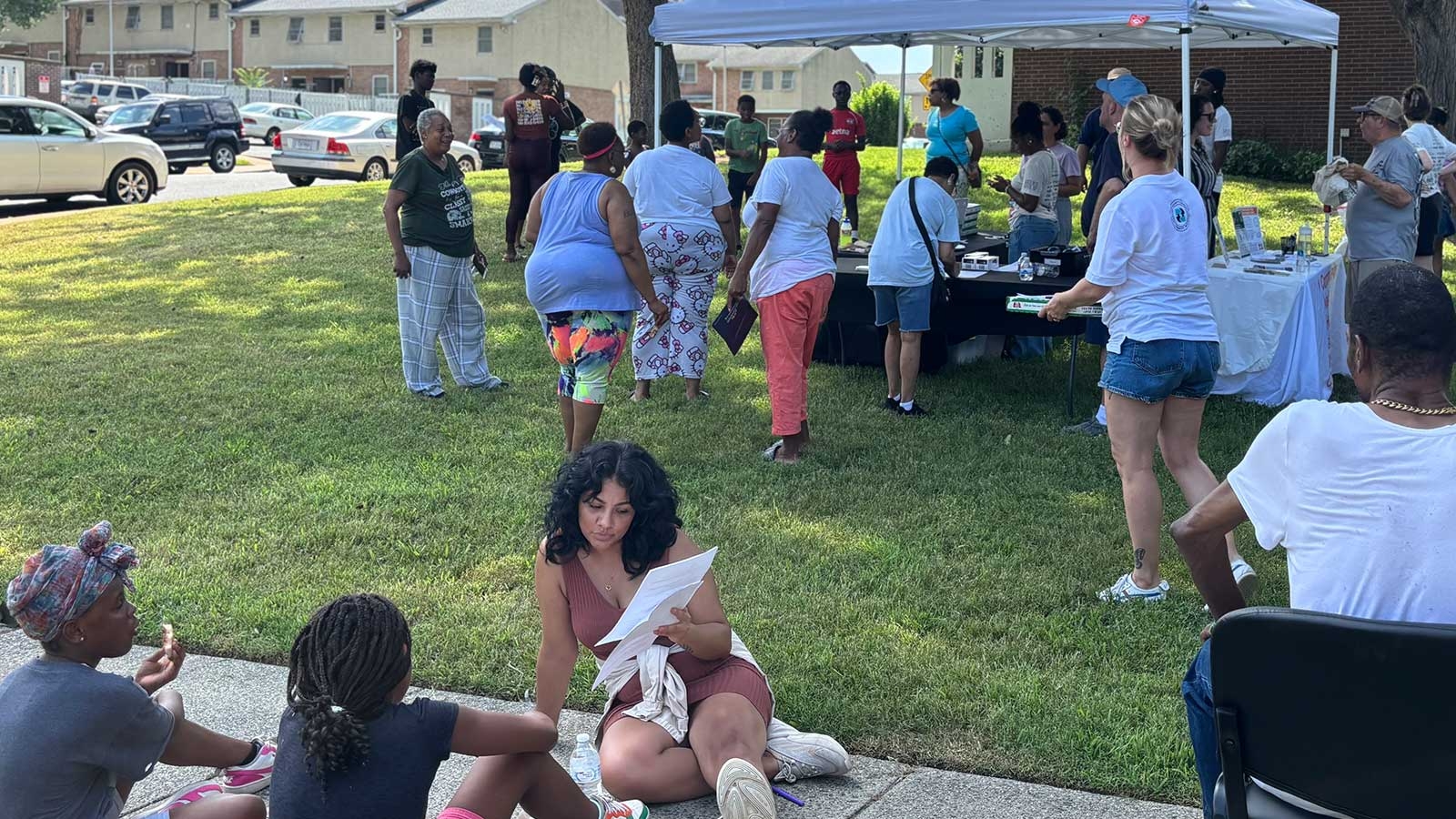
Data walk hosted by the Center of Community Partnerships in a Charlottesville neighborhood. Photo courtesy of the UVA Center for Community Partnerships. Photo credit: Sydney Shuler.
Finally, researchers and practitioners meet regularly and collaborate on novel contributions to the broader field, by co-presenting at research conferences and co-writing manuscripts under review in academic journals. The research coming out of the RPP is rooted in solving local problems of practice and facilitated through regular communication and a commitment to mutual benefit.
Faculty Collaborations
Faculty partnerships are essential to the Center’s mission. Faculty bring discipline-specific knowledge and a commitment to co-creating solutions alongside community partners. Rather than positioning faculty as outside experts, the work starts in the community and then invites faculty to contribute to and learn from that foundation. This reduces the burden on faculty, allowing them to align their research or teaching goals with community-driven priorities while benefiting from the Center’s established trust and infrastructure.
For example, in collaboration with UVA Law School clinics, the Center works to support community members and grassroots organizations navigating issues related to housing, safety, and governance. The clinics’ work complements ongoing community efforts by embedding legal and policy expertise into local nonprofit strategies.
Similarly, other faculty have partnered around mutually beneficial research in education. Within the ICG-funded RPP with the school district, the Center has partnered with early-career faculty to help relieve the burden of the tenure-track by co-designing research while uplifting their commitment to community-engaged scholarship. The Center helps to connect faculty to their local network of school partners and provide access and support to data, and faculty bring an expertise in content areas or specific methodologies to help expand the research possibilities in the RPP.
The model ensures that faculty who partner do not need to “start from scratch” to engage ethically and effectively with communities. Instead, they are welcomed into existing relationships that center mutuality, which contributes to the overall sustainability of the work.
Measuring Impacts
The Center understands our impact through the existence of sustained and enduring partnerships across the community. We engage in active partnership in a myriad of ways including ongoing community checks and balances, focused dissemination, and intentional reflection and evaluation before, throughout, and at the end of project milestones.
Below are strategies and questions for reflection the Center uses for measuring their impact in the community (adapted from the Methods for Community Engagement Toolkit):
The Center is driven by multiple community advisory boards that review new partnerships, research designs, products, policies, and publications. These boards help ensure institutional accountability to the community.
- Reflection questions:
- How am I ensuring community voices are heard throughout the research process (beginning, middle, end)?
- What steps am I taking to plan for power imbalances?
Throughout the research process, the Center engages with community partners to undergo focused reflection and review and intentional dissemination. The goal of this is to ensure that the work is community-generated, transparent, and accessible.
- Reflection questions:
- Have I ensured that (when possible) data, reports, and publications are open and accessible to the community?
- Have I demonstrated long-term commitment beyond the scope of the research project?
Transforming University-Community Relationships
The Center for Community Partnerships bridges the university and community in service of mutually beneficial, action-oriented change. By utilizing strategies such as RPPs, leaning into institutional partnerships, and holistically measuring impacts, the Center amplifies its core values of mutual benefit, humility, and authentic partnership. These approaches lead to transformed university-community relationships and more positive and connected outcomes for all.