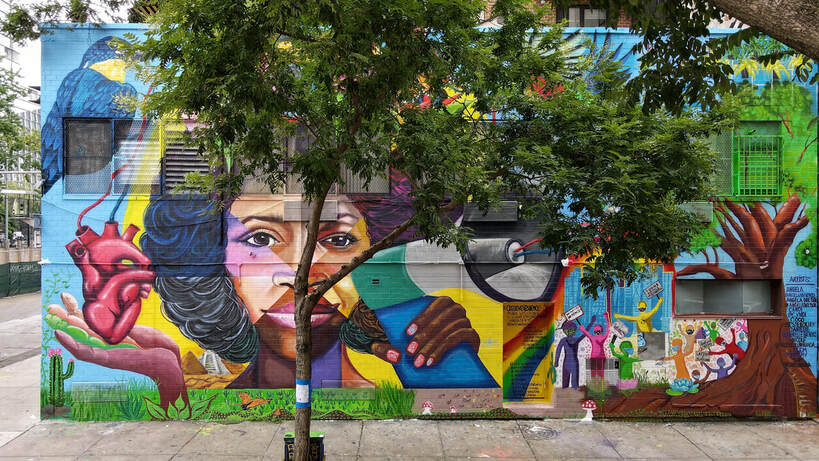
Photo courtesy of Brave House. Credit: @just_a_spectator
Finding a sanctuary to feel safe, seen, and supported can be life-changing. This is especially true for young immigrant women navigating trauma and new environments.
The Brave House, a local nonprofit, has become such a sanctuary for hundreds of young immigrant women and gender-expansive youth in New York City. Through free legal aid and holistic services, the Brave House helps community members secure the mobility and freedom to pursue dreams of their own choosing.
The Foundation aims to strengthen the infrastructure, leadership, and long-term sustainability of organizations like the Brave House through our Youth Service Capacity-Building Grants program. The goal of the program is nurturing stronger, more stable youth-serving organizations that tackle inequality in youth outcomes.
A new grantee, the Brave House is taking an innovative approach to building capacity. By elevating participants’ voices, representing the community with intention, and promoting leaders with lived experience, the organization is not only building on existing strengths, but exemplifying what inclusive, community-rooted leadership looks like. With their grant, the Brave House will implement a leadership succession plan to train an alumna, Yaniel Winters, to become the organization’s next executive director.
As the organization prepares for a major leadership transition, we sat down with founder Lauren Blodgett to discuss the organization’s roots, its impact, and its future. Our conversation covers how and when the Brave House identified their capacity-building plan, how it will strengthen the organization, and how they’ve designed the plan to unfold in phases.
Could you walk us through the capacity-building project for your grant—a leadership succession plan?
This has been part of the ideation behind the Brave House since day one. I am an immigration attorney, and I started the Brave House with 10 of my clients about seven years ago. The idea was always that eventually I wanted the leader of this organization to be a young immigrant woman who has the lived experiences and really is part of the community in the deepest sense of the word. Since the beginning, we’ve been thinking, how do we create a pathway to leadership within the organization? Now that we’re seven years in, it’s pretty cool that the time is ripe to put it into place.
Yaniel is going to be stepping into leadership with me. She was one of the first 10 members of the Brave House and participated in our programming for years, then was in our very first cohort of our youth leadership board, which we launched in 2020. That’s a cohort of young women who meet every month to do leadership development—public speaking, budgeting, goal setting, time management. [Yaniel] participated in that, and then eventually graduated from our programming—aged out, so to speak—and joined our advisory board. She was our first ever alumni on our advisory board that’s all young professionals, and then we were able to hire her to full-time staff earlier this year.
In terms of the succession plan that we submitted to William T. Grant, that was almost presented as the first step, but it’s really the 10th step, in a sense. That’s where we are right now. She’s full-time staff with us. She’s in charge of our leadership initiatives—the programming that she used to participate in—[and] now she’s running and leading and really excelling at that. She’s just crushing it in that area. She’s also spending this year shadowing what I’m doing, the work as an executive director. She’s getting to witness that before it will eventually become her responsibility. She’s in the mentoring, learning, shadowing, observing phase right now, and this fall, we’re launching more of a structured, deep dive into her development skills, specifically as an ED.
Next spring, we will launch a co-ED model so the two of us will be leading the organization together. That is part of what we’re figuring out in the fall: More granularly, what will that look like? How do we work together? How do our strengths and weaknesses complement each other as co-EDs? Then the next phase will be that she will take the helm on her own.
This leadership succession model has been in the works since the Brave House’s founding, but you mention that the moment is now ripe for this sort of transition. How did you identify that now is the right time for a shift in leadership?
Two moments come to mind, and they’re quite far apart from each other. It’s the seed of creation versus implementation. The creation piece was knowing this should be part of our design from the very beginning. I had worked in so many nonprofits up until that point, and I always saw that unfortunately, the community that is being supported was almost never involved in any conversations about how the organization is designed, [in] programming. The leadership often didn’t reflect the community or even listen to the community. I [thought], we could do better. Why is that such an anomaly? I think most organizations would be stronger and more vibrant if the community was in leadership at the organization.
That’s where the seed came from, but then where I [thought], “Okay, it’s go time, we’re ready,” was after about five or six years of really doing the work. I wanted to be able to fine tune our model of what we do and have all of our internal policies and systems. I wanted it to be a well-oiled machine that is still adaptable and shiftable, but at least have everything up and running in a way that feels good and comfortable and responsible before passing it to someone else. I’ve heard other stories of folks that try to involve the community in leadership from the very beginning, but it’s done in a way that’s not setting people up for success. It’s this balance of not waiting too long, but also giving it enough time so that it felt like the organization was in a healthy place—financially, systems, compliance, programming, all of that—before making the shift.
How did the leadership succession model come about? Did you consider other models to bring community representation into organizational leadership before landing on this iteration?
I had spoken to another founder, and she was very candid about what worked and what didn’t. I wanted it to be this tiered approach of participation in our programs, and then being a leader within our programs, and then the next step is the advisory board, or some other folks have done internships with us. This gradual implementation has been the plan pretty early on, after having some of those conversations about folks that went from zero to 60 and that not working well. From early on, I had the idea of, let’s do it in an intentional and methodical way, even if my enthusiasm and excitement is for this to happen tomorrow.
How has your background shaped your approach to creating trauma-informed, culturally responsive legal and social support?
Personally, being a survivor myself, I thought, “Wow, wouldn’t it be great if there was a nonprofit that was holistic, that saw somebody as a whole person, instead of segmenting their needs into 20 different needs, as if they’re not connected?” [Also] having a peer community of young women where you’re like, “I’m not alone. I’m not the only person that’s going through X, Y, Z.” Especially in the midst of this loneliness epidemic, creating a place of belonging is huge for mental and physical health. As someone who has gone through my own personal challenges, I wanted to create the organization that I wish existed.
My experiences as an immigration attorney also informed wanting to create this trauma-informed haven of support for young women. I would meet with my clients at that time before I started the Brave House—I worked exclusively with unaccompanied minors, so children coming to the U.S. alone without the support of family, and all survivors of gender-based violence—and as their lawyer, the legal case is the most important thing, right? But I would sit down with them, and they’d [ask], “Just real quick before we get into legal, how do I get health insurance? How do I enroll in classes? I don’t have any friends, how do I make friends here?” Peppering me with questions, and then either I don’t know the answer or the best I can do is write it on a sticky note. [I] realized that I can at least solve the community piece, because I know 70 of you who could be friends with each other, but then also the holistic piece. I just wish that after our legal meeting, you can go down the hall and meet with a therapist, and then you could stay after for some art class or community programming, and down the hall you can go to our donation boutique and get feminine hygiene products or food or toothpaste. That desire came from working within a system that I felt like wasn’t working and feeling like we could create something better together.
How have you seen Yaniel grow during her time at the Brave House and as she steps into a leadership role?
Seeing Yaniel in action is just so inspiring. She’s so smart and capable, and she adds so much value to the team. She sees things that I don’t see. She asks really good questions, but I would say above and beyond, she just serves as an example of what’s possible to other members. Now that she’s on staff, other members are like, “Hey, how can I be on staff? I want to work at the Brave House.” The point of representation is being able to see yourself in whatever role. Having someone who reflects the identities that you hold, the values that you hold, the experiences that you share, it just unlocks something in others that they just see so much more possibility for themselves. I would say that’s one of the most beautiful things that I get to witness with Yaniel, not just the value she adds to the team, but what it also demonstrates to the entire Brave House community.
How do you navigate the emotional toll of supporting trauma survivors while also maintaining momentum for organizational growth?
There’s something that we talk a lot about in this work called vicarious trauma, which is very real when you’re working in these really intense environments and situations. Something we also talk about at the Brave House is vicarious resilience, getting so much from witnessing the resilience of our community and how that really fills us up, and it makes us want to work deeper. [It’s] this deeper commitment to the work that is so contagious when you see it in somebody else.
That being said, we also do take some concrete steps toward preventing burnout and taking care of ourselves. We have this internal staff policy where every month, each staff member is required to take a mental health day proactively. We call them bloom days. It’s different than a vacation day—it’s a mental health day that you put on the calendar, months in advance, and you just do whatever you need for your mental health. You go to a park, or maybe you do your laundry, or you sleep. We put it in the calendar so everyone can see each other’s bloom days. It’s inspiring to [see] my other teammates taking a day to rest or to take care of their mental health, aside from weekends and vacations. It creates a culture where that is allowed and normalized and actually required, as opposed to what can often happen in workplaces where everyone’s really passionate, where everyone’s working seven days a week, so I should be working seven days a week, and if I’m not working seven days a week, it means I don’t care as much as everyone else. It’s something that we do take seriously because we all want to be able to do this for a very long time, not just for a flash in the pan and then you’re so burnt out that you can never do this work again.
###