An important democratic institution, the court remains a space for social transformation where rulings have the potential to reduce or exacerbate youth inequity. Two famous cases exemplify this point. Brown v. Board of Education (1954) (“Brown”) struck down laws that prevented K-12 students from attending racially integrated schools.1 Similarly, Plyler v. Doe (1982) (“Plyler”) struck down laws that prevented undocumented youth from attending public schools. Brown and Plyler offer the promise of a multi-racial democracy and integrated schools that support youth to achieve their best, regardless of race or immigration status.
Its transformative power makes the court a fertile space for the use of social science research in service of improving youth outcomes. Research can provide a fuller picture of the social realities implicated in the cases before the courts and thereby, alongside other sources of evidence, inform the courts’ decision-making. Parties in legal cases and judges have long used research to make sense of the cases and the legal questions before them. One of the earliest recorded examples of this dates back to 1895 when the parties in Ritchie v. People submitted legal briefs that included references to social science research (Morag-Levine, 2013). Since then, other high-profile instances of research use in court have involved youth cases, including the U.S. Supreme Court’s use of psychological research in Brown to support the argument that racial segregation is inherently unequal because of the negative effect that it has on Black youth (Heise, 2005).
Despite the prevalent use of research in court cases and existing studies on understanding research use in court, strategies and conditions to improve the systematic and routine use of research in legal decision-making are understudied. For this reason, this essay encourages research investigating the improvement of research use in court. Put simply, improving research use in court is important because research can support the court in reaching outcomes that advance youth equity. This essay extends the conversation by offering an overview of the court system and the opportunities for research use that exist in the system, a review of what the literature tells us about the use of research in court, and directions toward a comprehensive research agenda on improving the use of research in court.
The Court, Its Central Players, and Opportunities for Research Use
Studying ways to improve research use in court requires general knowledge of the court system. As such, I provide an overview of the structure of the court, its central players, and opportunities for research use throughout the complex process of litigation.
A General Overview of the Court
The court is a dispute resolution institution (American Bar Association, n.d.; Sander, 1976). This makes courts relevant across all social domains that involve conflicts that implicate youth. Where there is a social dispute with legal dimensions and no agreed upon solution, courts may weigh in if a party sues. Moreover, courts’ decisions directly affect the parties litigating the issues. Some court cases have sociological significance as well, with implications that extend beyond the parties before the court (e.g., questions about the legality of race-conscious admissions or questions about school funding at the state level). Research can play an important role in both types of cases (Proctor, 2024).
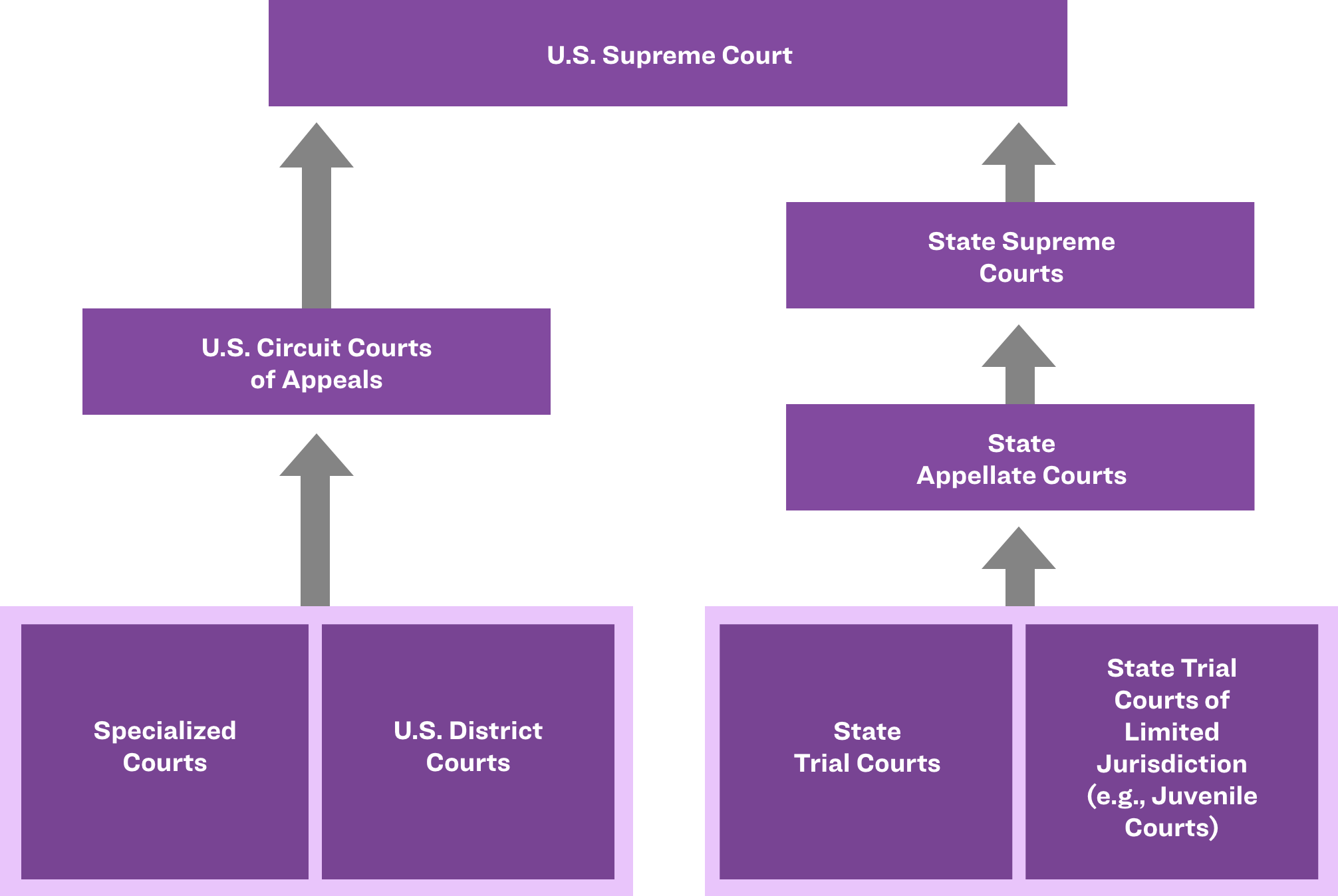
The court is composed of two main systems: federal and state courts (Friedman & Hayden, 2017). Figure 1, below, offers an overview of the structure of these systems. The federal and state systems run in parallel and bear significant resemblance to one another (Kim, 2014). Both include the same system structure: trial courts (and specialized courts, such as juvenile courts), initial appeals courts, and final appeals courts (Friedman & Hayden, 2017). Both can hear cases related to youth when they have jurisdiction over (i.e., “power over”) the parties and the legal issues in the case (Walsh, 1901). For instance, state courts have jurisdiction over education cases, because education is primarily the responsibility of the states (Hancock v. Commissioner of Education, 2005). But federal courts may also have jurisdiction over education cases when the violations of law implicate federal law, such as when a student claims a free speech violation (Tinker v. Des Moines, 1969).
Figure 1. Structure of Federal and State Court Systems. Open full-size in a new tab.
The Central Players
Resolving disputes through litigation involves the decision-making and input of two main groups of central players: (a) legal actors and (b) other actors engaged in the legal process (Friedman & Hayden, 2017).
Legal Actors
Lawyers are officers of the court who are ethically tasked with representing their clients’ interests with zealous advocacy. They must advise their clients about their options, but, ultimately, their clients have the final say regarding the case strategy they will pursue.
Judges are the final decision-makers regarding whether a violation of law has occurred in a given case. They must weigh the arguments that both parties present and rule on the legal issues guided by precedent (i.e., established legal doctrines that apply to similar legal questions) and the facts of the case. Sometimes they rule on a case single-handedly and sometimes alongside other peer judges in their court chambers. Judges serve at all levels, but judges who sit in the final appeals courts (e.g., the U.S. Supreme Court) are called Justices.
Law clerks may include multiple groups. Law students interning at law firms sometimes hold the title of law clerks. In this capacity, they may support lawyers in preparing for litigation. Law graduates who take a position with the court are also known as law clerks. These positions often last about a year or two. But law clerks might also be career clerks working in the court system long-term.
Sample of Other Actors Engaged in the Legal Process
Amici, or friends of the court, are any individuals or organizations that are not formal parties to the litigation but can submit briefs, known as amicus briefs, to inform the courts’ decision-making by shining light on issues before the courts. Amici do not need to be lawyers or legally trained, but the individuals filing the briefs on behalf of amici must be licensed attorneys. Amici have few limitations on what they can present to the court, like page or word limitations (e.g., Office of the Clerk, 2023).
Expert witnesses are specialized professionals (e.g., evaluators, scholars, or researchers) who testify before the court. The court has rules to determine whether someone is qualified to render an expert opinion in a given case. Scholars and practitioners, including youth-serving professionals, may serve as expert witnesses.
Youth-serving professionals are experts in fields dedicated to serving youth. This category is broad and may include, for example, social workers and neuropsychological evaluators. Youth-serving professionals may work with lawyers in court cases where their expertise is valuable. For instance, a neuropsychological evaluator may evaluate a young person to determine if they need special education services. Youth-serving professionals may also write reports that lawyers can use in litigation without serving as expert witnesses or they may testify in court as expert witnesses.
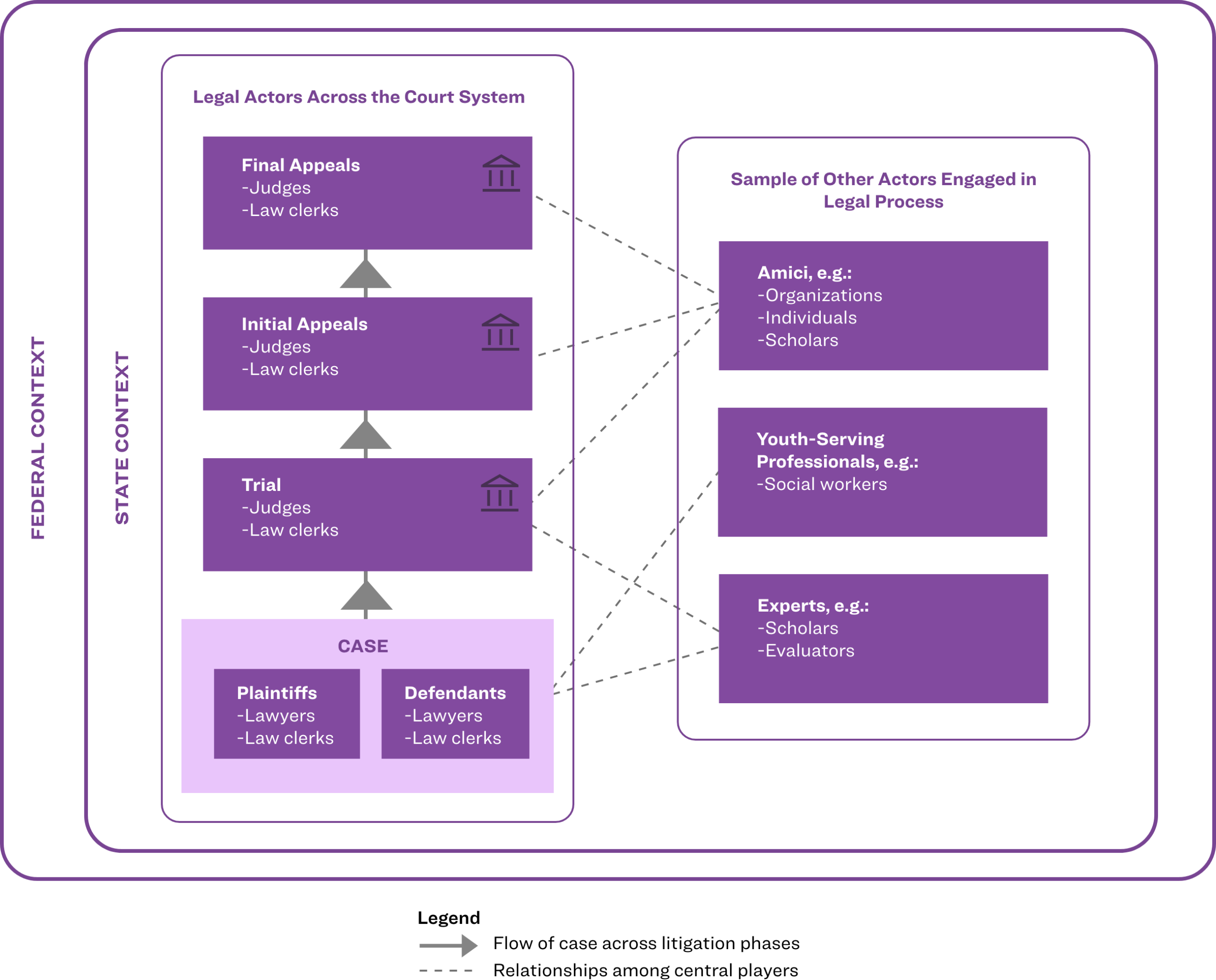
In Figure 2 below, I offer a diagram to conceptualize the relationship between the court and its central players along the life of a case through the litigation process. Importantly, the Figure also highlights that the court system is embedded in state and federal contexts—contexts which affect the laws, regulations, policies, and practices that govern the lives of youth and the legal issues that may surface in their cases.
Figure 2. Relationships Among Central Players Across the Life of a Court Case. Open full-size in a new tab.
Opportunities for Research Use Throughout the Litigation Process
Evidence, which plays a central role in the litigation process, takes specific forms (Kim, 2014). Facts of the case and applicable legal doctrines are the primary forms of evidence courts consider in their decision-making (i.e., primary sources). Every other type of evidence, including research, is known as a secondary source; it may inform the courts’ decision-making, but it is not binding on the courts. This means courts do not need to follow secondary sources to make decisions (Kim, 2014), though secondary sources play an important role in the decision-making process.
Once a lawyer has gathered the relevant evidence in a given case, they will file a lawsuit, beginning the litigation process in trial court. Litigation cases involve two opposing parties, the plaintiffs (i.e., the parties bringing the suit) and the defendants (i.e., the parties being sued). Plaintiffs decide what legal questions to bring before the courts—questions that ask about the legality of certain actions, policies, or practices. This stage of the process involves fact-finding, or, in other words, establishing the facts of the case and the scope of the issues before the court.
At the trial level, the primary sources of evidence that litigants offer to frame the issues before the courts are facts of the case and established legal doctrines applied to these facts (Kim, 2014). However, central players can use and broker other secondary sources, too. Amici, for instance, may submit briefs that cite research. In developing their litigation strategy, lawyers may rely on evidence-informed expertise that youth-serving professionals have offered them. Lawyers may also cite research in their legal briefs to share a broader sociological picture of the issues before the court. If the court holds a hearing, the lawyers may choose to call expert witnesses to testify. Expert testimony is often grounded on research knowledge. Judges and law clerks may also identify research themselves to help understand and frame the issues before them.
When a party loses at the trial level and there is an error in the court’s ruling, they can appeal to the next level: the initial appeals court (Division for Public Education, 2021; Kim, 2014). Appellate courts generally do not allow the introduction of new primary evidence, instead relying on established facts and pleadings submitted to the court by that point. Here, too, research evidence may make its way into the court through lawyer briefs that can cite directly to research or through amicus briefs.
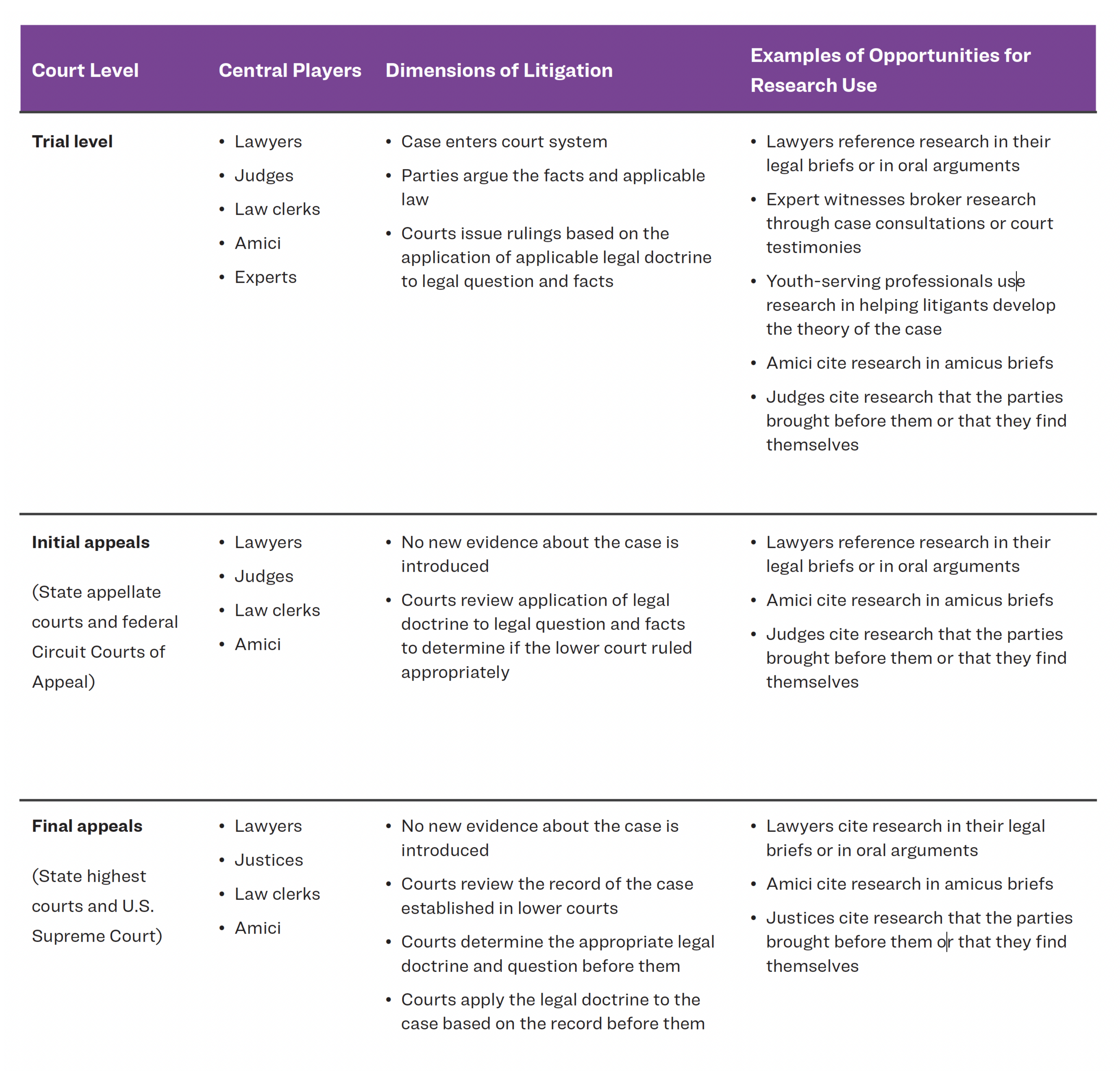
If the losing party is dissatisfied with the outcome of the case at the initial appeals level and there is an error, the party can appeal the decision to the final appeals court: the supreme court. The highest courts at the state level and the U.S. Supreme Court have the final decision on issues within their jurisdiction (Friedman & Hayden, 2017; Kim 2014). Generally, no new primary evidence regarding the case can be introduced, but central players can share secondary sources, including research. Table 1, below, synthesizes the federal and state court systems and identifies opportunities for research use throughout the different stages of litigation.
Table 1. The Court, Its Players, and Examples of Opportunities for Research Use. Open full-size in a new tab.
It is important to situate cases in court within the larger legal system. Most disputes with legal dimensions are settled out of court (Eisenberg & Lanvers, 2009). In these instances, lawyers may also use research to aid in their decision-making. Deterrents to filing a lawsuit exist as well, such as people not having enough resources (e.g., money) or access to a lawyer to sue (Minow, 2022). As such, courts are one form of dispute resolution, albeit a powerful one. With this overview, I turn to what the literature tells us about research use in court.
What Literature Tells Us About Research Use in Court
Despite the wealth of literature on research use in policy and practice, and more broadly across fields and disciplines (Farley-Ripple et al., 2020), the use of research in court remains comparatively understudied. The extant literature on research use in court is interdisciplinary, found in both law reviews and social science journals. This creates a larger knowledge base, albeit at times with disparate bodies of literature siloed by their own disciplinary jargon. It also has fewer empirical studies, as law reviews do not specialize in publishing empirical research. The literature has focused its analysis on formal legal documents, including court opinions, amicus briefs, and lawyer briefs. These sources are open access and do not present the same access challenges that other types of data collection (e.g., interviewing judges, observing confidential client meetings, observing closed court hearings, etc.) may present in the legal context. This focus on formal documents also points to the need for studies that integrate interview, survey, and observational data that capture the dynamics of the court system and its central players. Taken together, however, the extant literature has illuminated our collective understanding of research use in court in important ways. I review these non-exhaustive insights next.
Mapping the Foundations of Research Use
Scholarship has established that research use in court is a ubiquitous phenomenon (e.g., Bisaccia Meitl, 2020). The presence and use of research in court occurs across all court levels and by the multitude of central players. Research is one tool amongst other important tools that help central court players make decisions. For instance, researchers span boundaries (Garces, Hinga, & Rios-Aguilar, 2021) and serve as knowledge brokers when they testify, join in the writing of amicus briefs, or work with lawyers in building the theory of a case, to name a few mechanisms they use to broker knowledge to the court.
The scholarly literature catalogues research, alongside other types of secondary sources, using different nomenclature, such as “non-adjudicative facts,” “legislative facts,” “non-legal facts or information,” and “extra-legal sources” (Dyk, 2023; Garces et al., 2017, 2021; Proctor, 2024). Legal briefs that include these types of sources are sometimes referred to as “Brandeis briefs, ”alluding to a famous brief that Justice Louis Brandeis wrote when he was a lawyer (Ishitani, 2024). The brief supported workplace hour limits and extensively incorporated sociological research that outlined the negative impact of long working hours on employees (Doro, 1958). They have since been used widely, including, as noted above, in one of the highest profile cases in history: Brown. This case ended legal racial segregation in education, transforming the lives of millions of youth.
Moreover, as scholars have noted, research use in court lacks standardization, because the legal profession lacks rules requiring training in research and its use in legal education or law practice (Margolis, 2000). Judges and other central players may also decide not to cite the research on which they rely when crafting their arguments and articulating their reasoning (Carter, 2019; Dursht, 1996), making it difficult to identify research use. This lack of standardization has created an inconsistent pattern of research use in court that persists (Proctor, 2024; Reinhard, 2020).
Mapping Types of Research Used
In this landscape characterized by inconsistency, central players in courts use a large swath of sources that communicate research findings. For instance, in distinct studies, Garces, Marin, & Horn (2017, 2021) and myself and colleagues (2023) found that judges and amici commonly used the following sources: articles, books, book chapters, peer-reviewed articles, fact sheets, policy briefs, and organizational research reports. These sources communicated and translated research findings and ideas to other central players involved in the legal cases.
But not all evidence is equal before the courts. Central players draw on some particular types of research more than others depending on the venue where the source is published. For instance, research finds that courts may be more likely to use sources that make research findings more accessible (e.g., news stories reporting on studies), rather than citing the studies themselves (Garces et al., 2017). Moreover, although this has ebbed and flowed across time, law reviews have a long tradition of use in courts (e.g., Newton, 2012), suggesting the importance of publishing in different types of venues that go beyond social science journals. Law firms and courts have access to legal databases to access primary legal sources, such as Bloomberg Law, LexisNexis, and WestLaw, and these databases also publish law reviews. Central players may not have access to databases indexing social science journals, however, impeding easy access to these secondary sources.
“Not all evidence is equal before the courts. Central players draw on some particular types of research more than others depending on the venue where the source is published.”
Research use in court also depends on the types of cases and legal questions before the courts. History research, for instance, is of particular interest to the courts when adjudicating constitutional matters, because it gives them a better understanding of the history surrounding constitutional principles and amendments (Ishitani, 2024). My own research with colleague Nate Hutcherson (2024) found that Justices across ideologies used research to retell the history of race and racial discrimination in the U.S. in the race-conscious college admissions case Students for Fair Admissions v. Harvard/UNC in 2023. This use of research supported the Justices’ ruling that higher education institutions cannot explicitly use race in undergraduate college admissions.
Mapping the Influence of Ideologies and Politics
Similar to research use in policy and practice contexts (Finnigan, 2023; Lubienski et al., 2014; Scott & Jabbar, 2014), the politics of research use is another important factor that shapes the use of research in courts. This means that central players use research in ways that speak to the ideological leanings of their immediate audience, such as conservative judges (Muñiz et al., 2025). This also means that courts will use research in ways that are ideological, or may not use research for ideological reasons. Regarding the latter, the literature has documented that conservative-leaning judges tend to rely less on research in their judicial decision-making when compared to their liberal-leaning counterparts (e.g., Acker, 1993; Garces et al., 2017). Justice John Roberts, a known conservative-leaning Justice, infamously labeled sociological research “gobbledygook” and noted that it should not be a deciding factor in cases (Reinhard, 2020).
However, a uniform binary ideological division of research use does not exist. Conservative judges have used research, including to uphold the autonomy of higher education institutions during COVID-19 (Muñiz & Hutcherson, 2022), and have, at times, been the ones who use the most research in their arguments when compared to other judges ruling on the same case (Muñiz & Hutcherson, 2024). Justice Roberts most recently used research extensively in United States v. Skrimetti (2025), rationalizing that the medical research community disagrees about whether certain medication is gender-affirming for transgender youth. Although, in these instances of conservative judges using research, the research was medical not sociological, which may suggest that conservative judges may be more amenable to use some types of research over others.
As this section demonstrates, scholars have identified that research use is commonplace in courts, the types of research courts use, and in what ways they use it. The existing literature offers a strong foundation to begin studying strategies and mechanisms to improve the use of research evidence in court. I turn to this concern next.
Directions for a Comprehensive Research Agenda
Building on the ideas already outlined in this essay, in this section I highlight important considerations for advancing a comprehensive research agenda on improving the use of research in court in service of reducing youth inequity. While these considerations are intertwined, I discuss them separately to allow for deeper exploration.
Use of Research Toward “Just Ends”: Questions of Power and (In)Equity
In 2022, Vivian Tseng argued that research use cannot be divorced from the injustices that affect youth:
“The use of research evidence is as embroiled in racial hierarchies as the rest of our society. The people who define whether research is useful are often society’s elites, and rarely do the communities who are supposed to benefit from research get to define what makes research useful (Doucet, 2019). Moreover, the research that gets promulgated and used is subject to the same racial biases that are embedded in our research and policy institutions.”
The research agenda I encourage in this essay centers this concern. Studies that consider the role of structural inequality in how and by whom evidence is used are significantly underrepresented in the research use literature (Muñiz & Okello et al., 2025). Scholars have recently called for a focused inquiry into this dimension of research use (Doucet, 2019, 2021; Bohannon et al., 2024; Finnigan, 2025).
To this end, critical theories and frameworks that enable researchers to hone in on questions of power and (in)equity are important. This is because drawing attention to issues of power and (in)equity in research use in court makes inequity visible and tangible, directs researchers’ attention to the mechanisms and processes that maintain that inequity, and aids them in identifying promising pathways towards disrupting inequity. Investigations with this focus must also account for the challenges of research use in the legal context, including the politicization of law itself (Lewis et al., 2022) and the ideological use of research by the various central court players (Muñiz & Hutcherson, 2022, 2024).
To exemplify what investigations with a focus on power and (in)equity can look like, consider the following examples. Investigations may ask questions about whether and how to shift power dynamics among (senior) judges and youth-serving lawyers to influence the brokering of research to the court. Investigators may also ask questions about how to shift dimensions of power, e.g., gender, race, class, elitism, etc., to influence how the judges receive this very research. For example, investigators may ask: What systems can courts adopt to reduce power disparities across judges and lawyers? What disparities-reducing systems can courts adopt to enable lawyers to present research in cases more effectively and judges to uptake the same in their court opinions? Other investigations may focus on power dynamics outside of the court. These investigations may focus on how youth-serving lawyers prepare court cases, who they involve in the process, who brokers research in these cases (e.g., law clerks) and to which central players, and how lawyers ultimately engage with research as a result of these relational interactions.
Lastly, critical theories invite investigators to center equitable outcomes for youth as a main goal. It is important to note that “equitable outcomes” are contextual and may involve short- and long-term outcomes. For instance, in my own research with colleagues Maria M. Lewis and Nate Hutcherson (2025), we introduced “Critical Knowledge Brokering,” a critical conceptual framework, to study how amici brokered research to the U.S. Supreme Court. We found that amici brokered an array of research that was both critical and non-critical of systems of oppression. Amici’s use of research served a short-term goal—their equitable outcome focused on the immediate outcome of the case, despite the outcome of the case being a temporary fix to larger systemic issues in immigration law. Their knowledge brokering in the court informed a short-term win, but may also inform long-term solutions as it shapes broader policy immigration discourse (Muñiz et al., 2023). In sum, research that focuses on improving the use of research toward reducing inequity benefits from considering differences in short- and long-term equity outcomes.
Theoretical Frameworks
While above I discuss critical frames through which to approach investigations, here I draw specific attention to theoretical frameworks more broadly. Theoretical frameworks have an explanatory power to better examine strategies to improve research use in court. Because questions of how we improve research use in court in support of youth involve the legal system and other youth-serving systems, social relationships, and organizations, I draw attention to systems theories, organizational theories, and social networks theories.
“Theoretical frameworks have an explanatory power to better examine strategies to improve research use in court.”
Systems theories across fields can be generative in studying how to improve the use of research in court because they provide theoretical grounding that may be applied to the complex legal system (Cabrera & Cabrera, 2023). Systems theories give us a framework to examine systems, its parts, and how their interactions lead to certain outcomes, for example, the improved use of research and reduction of inequity. Studies can explore the relationship between the systematic and routine use of research by central players across court systems and outcomes. For instance, building on literature that identifies the importance of infrastructure to improving research use (Tseng & Nutley, 2014), investigators may build and test strategies to improve the routine use of research in juvenile state courts with different system infrastructures to improve outcomes for youth. Similarly, researchers may longitudinally study whether and how the routine use of research shapes the decision-making process of different central players and youth outcomes across the life of the case in litigation, from trial to the final appeals court. This research would help surface the gaps regarding research use across systems, barriers to adopting systematic and routine integration of research, and potential promising practices to improve research use.
Organizational theories are key to examining how to improve research use in courts. Organizational theories are rich and focus on issues within and beyond organizations, with theories focusing on structure, culture, relations, institutions, professions, transformation, and social conflict (Trinidad, 2025; in press). Investigations in this vein may ask questions focused on structures, such as: What routines do judges and law clerks adopt that lead to increased use of research in youth court cases? They may also ask questions focused on culture, such as: What type of organizational culture, values, and climate at law firms leads to improved research use in youth cases? Complementarily, investigations may focus on macro-dynamics. They may ask questions such as whether certain strategies that publicize how courts integrate research may lead to isomorphism (i.e., other courts adopting similar approaches).
Lastly, a focus on the relationships across and among legal actors and others involved in legal cases is important. Social network theory may enable researchers to identify whether research use improves if and when homophily exists, i.e., when people with similar backgrounds, values, or beliefs come together. For instance, If interdisciplinary teams of lawyers and researchers collaborate as amici, does that lead to the integration of quality research in amicus briefs? What happens when homophily is absent? Moreover, the literature finds that loosely connected networks promote innovation and diversity of ideas (Burt, 1992; Cárdenas, 2021; Granovetter, 1973; Obstfeld, 2005). Might a lack of densely connected networks amplify the diversity of types of research that amici adopt in their amicus briefs, leading to use of richer, higher-quality research?
Complex Relationships Among Central Players
Researchers studying research use in policy and practice have brought to bear the critical role of social networks and organizational behavior in shaping the ways that research is brokered and informs decision-making (Bohannon et al., 2024; Caduff et al., 2024; Coburn et al., 2013; Coburn et al., 2020; Daly & Finnigan, 2012; Finnigan et al., 2021; Finnigan, 2025). This enhances our understanding of research use, reframing it as a complex dynamic among actors whose relationships are key to how research is used, if at all. These insights offer a lens through which to begin to study the improvement of research use in courts, drawing a focus to the complex dynamics amongst central players in courts.
As exemplified above, the legal system is complex. Studies can capture some of the complexity by studying issues that implicate the relationships among multiple central players in courts. Investigations may focus on issues, strategies, and mechanisms that improve the use of research between and amongst the two main groups of central players: (a) legal actors and (b) other actors engaged in the legal process. Studies may hone in on distinct central players to identify the strategies and conditions that affect specific groups, as well as to study the relationships amongst different players.
To illustrate, investigators may design studies to identify the brokering strategies that law clerks use to broker knowledge to the judges as they write court opinions and thereby identify strategies that improve judges’ use of research. More specifically, investigators may ask: What research brokering strategies do law clerks employ when researching and drafting court opinions? What successful strategies do law clerks use when discussing cases with judges that may effectively improve the use of research in court opinions? Who in law clerks’ knowledge ecosystem do clerks rely on as they decide what research to seek and how to integrate it in their drafting of court opinions?
Investigations may also identify and test what conditions (e.g., court level, type of case, state context) lead to improving the use of research in court outcomes when lawyers, in collaboration with others, use research in their arguments. For example, investigators may ask: How do the relationships amongst legal and other actors engaged in the legal process shape different phases of litigation and how do the differences across phases influence research use?
Moreover, in complex social ecosystems, relationships are created and dissolved over time, creating different conduits through which knowledge may be diffused. Research questions may focus on the creation and dissolution of relationships and what that means for the improvement of research use in youth cases. For instance, does the creation or dissolution of relationships and trust among certain central players improve the use of research? More specifically, for example, if a judge trusts a lawyer in the case given the lawyer’s reputation, is the judge more likely to trust and use the research that lawyer introduces to the court, or does a judge’s use of research decrease when they are more skeptical of the lawyer? These types of research questions can identify whether and how as relationships shift, research use improves or decreases in courts. This line of inquiry is promising, as social network research in education shows that the creation and dissolution of ties shapes research use (Daly & Finnigan, 2012).
Interdisciplinary Research Teams
Empirical studies of research use often come from siloed fields (Farley-Ripple et al., 2020). As scholars study strategies to improve the use of research in court, it is important to heed the calls that scholars such as Farley-Ripple et al. (2020) have advanced. That is, scholars must draw on and build upon the broad knowledge base across disciplines studying research use in policy and practice contexts (e.g., Bohannon et al., 2024; Coburn et al., 2021; Farley-Ripple, 2024; DuMont, 2024, 2025; Farley-Ripple et al., 2018; Farrell et al., 2022; Finnigan, 2012; Finnigan et al., 2021; Gamoran, 2018; Honig et al., 2017; Lubienski et al., 2014; Muñiz, Lewis & Hutcherson, 2025; Penuel et al., 2017; Scott & Jabbar, 2014). Interdisciplinarity in the study of improving research use in courts is key for at least several reasons. Legal issues in youth cases implicate legal, sociological, and systemic dimensions, to name a few. As such, experts in these areas can provide different angles and additional nuance to a study and its design. In this way, interdisciplinarity enables researchers to draw out the richness of phenomenon from multiple angles and positions them to offer robust recommendations that account for the nuances present in youth cases.
“Interdisciplinarity enables researchers to draw out the richness of phenomenon from multiple angles and positions them to offer robust recommendations that account for the nuances present in youth cases.”
Teams that integrate expertise from across fields can support investigators in achieving this. One mechanism to create these teams is research-practice partnerships (RPPs). The research use literature identifies RPPs as promising partnerships that support the diffusion of research into practice and can improve research use (Coburn et al., 2021; Farrell et al., 2021; Finnigan, 2025; Penuel et al., 2015). Interdisciplinary investigations in this vein might lead to partnerships between researchers and legal practitioners and other youth-serving professionals. For instance, studies may involve partnerships between social science investigators who are experts in research design and research use; State Attorneys General who are experts in their states’ legal systems, rules, and structures; and other youth-serving professionals, such as social workers and state child protective service staff who are experts on youth issues. Other investigations may include social science researchers partnering with law professors who are experts in specific areas of law; social science researchers working with practicing lawyers who are experts in their law practice and know the processes in court; or social science researchers partnering with law clerks and judges who make the final decisions in the cases. Each expert in the team brings different lenses that can enrich the research process from beginning to end.
To be clear, not every study needs to be interdisciplinary, and studies that are not interdisciplinary are equally important. Rather, this agenda recognizes the value that interdisciplinary research can bring to our understanding of how to improve research use in court to reduce youth inequity.
Quality of Research and Impact of Use
While studies have identified the type of research courts use (e.g., Garces, Marin, & Horn, 2017, 2021; Muñiz & Hutcherson, 2022, 2024), there is less explicit focus on examining the quality of the research itself and measuring or mapping the impact of the use, particularly on case and youth outcomes.
Regarding quality, studies that categorize or create measures or typologies to identify the quality of research and its use in court would be significant. For instance, a study may identify working criteria for what constitutes quality research (e.g., systematic analysis of data with guiding questions); create a typology that classifies research from high to low quality based on the criteria; and examine whether the secondary sources that lawyers and judges use fit the typology. This type of investigation would set a foundation regarding quality research, similar to the typologies already established in the research use in law space that categorizes the types of secondary sources lawyers and judges use.
Moreover, research designs that employ or develop measures regarding the impact of the use of such research would also be an important next step. For instance, after developing such classifications, studies may investigate whether and how lawyers or judges filter in and out quality research in their decision-making process and in their final briefs and rulings, respectively. This should be coupled with questions related to how we improve the use of such quality research and what conditions and contexts lead to an impact that reduces youth inequity. For example, does having more law clerks trained in interdisciplinary fields lead to the integration of higher quality research in court opinions and decisions? Does such interdisciplinary approach lead to reductions on youth inequity?
It is important to note that questions of impact are difficult to assess in the legal context because judges rely on a multitude of sources, and research, when used, is but one factor in their analysis. Moreover, impact of research use is also difficult to track, because central players may not cite the research in articulating their reasoning (Carter, 2019; Dursht, 1996). Nonetheless, illustrative examples of the impact of research use come from scholarship of amicus briefs brokering knowledge, as well as of judges relying on research to contextualize their rulings or make legal determinations (Garces et al., 2017; Muñiz & Hutcherson, 2022, 2024). In the latter instance, judges explicitly reference the research, suggesting it has some influence, but the extent of the influence remains uncertain.
As noted above, all of these considerations may be intertwined, and, as such, I offer an illustrative study that integrates some of these considerations together.
An Illustrative Study
Since 2024, with the support of the William T. Grant Foundation Scholars Program, I have been working closely with the EdLaw Project, a unit of education law attorneys housed within the juvenile public defender’s office in Massachusetts, who seek to disrupt the cradle-to-prison pipeline through evidence-informed lawyering. Their organizational mission is centered on youth equity (Muñiz, 2024-2029).
The organization is uniquely positioned in Massachusetts. The Commonwealth employs a holistic approach to youth advocacy, including through the establishment of the EdLaw Project, a unit under the Youth Advocacy Division of the Massachusetts’ Committee for Public Counsel Services. Through EdLaw, the Commonwealth advances the educational rights of young people. The animating idea behind EdLaw’s work is that young people who come in contact with the legal system or who are in environments that increase their risk of becoming involved with the legal system experience, or likely have already experienced, a disruption to their education. Young people may find themselves excluded from school or attending schools that fail to provide them with the appropriate services to which they are entitled by law. Moreover, research has established that a disruption to a young person’s education and their engagement with the court system increases their likelihood of being tracked down a pathway towards the industrial prison complex. Therefore, ensuring that young people receive the education they are legally entitled to is an intervention that can help orient the young person’s trajectory away from the industrial prison complex and towards the pursuit of their goals and dreams.
In the study of EdLaw, I use an interdisciplinary lens, drawing from organizational and network theory and research on the use of research, to study how their social networks shape EdLaw’s routine use of research. I pay particular attention to the organizational context and systems (e.g., Massachusetts, youth-serving state systems, etc.) in which EdLaw is embedded. More specifically, the following overarching question guides the study:
What strategies and conditions, shaped by EdLaw’s social networks within and outside the organization, aid the organization to foster routine use of research in youth legal advocacy as they broker knowledge within and outside the organization?
My research design is longitudinal and qualitative in nature, with a particular focus on open-ended inquiry that enables the research team to identify strategies and conditions as EdLaw develops and employs them. Preliminary insights show the power that developing a culture that centers research use as part of their ongoing legal practice is key. Intentionally bringing together interdisciplinary teams as an organizational strategy is also significant in shaping the lawyers’ use of research. For instance, they work closely with social workers and youth-serving professionals, such as evaluators, who help EdLaw lawyers identify the appropriate services for youth while being guided by applicable legal issues and doctrines. In other words, preliminary insights show that working in interdisciplinary teams improves EdLaw’s routine research use in practice. A next step is to further disseminate these findings and track whether research use changes as these relationships change over time.
In Sum
Courts are important institutions that shape youth inequity. They are multi-structured and involve various central players that use research throughout the litigation process. Despite what we know about the ubiquitous use of research in courts, we need more studies of how to improve research use in courts, because, as noted above, legal rulings can improve the lives of youth. With a focus on reducing youth inequity, this essay offers some considerations about how to advance a research agenda on improving the use of research in courts.